
 By
By 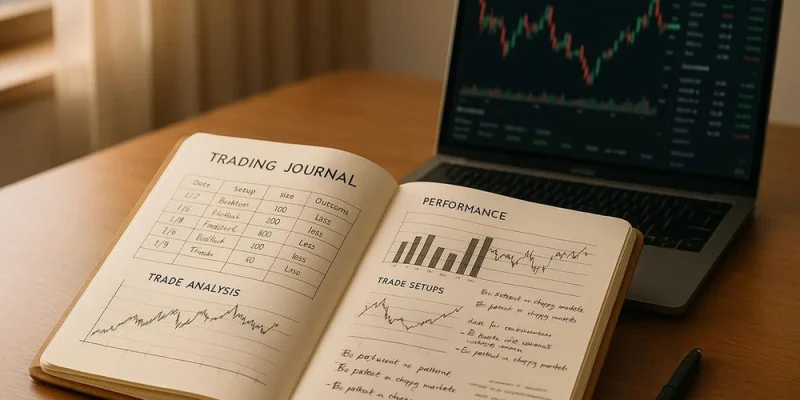
A trading journal helps traders understand the decisions behind their profits and losses. By recording trade details, strategies, and market conditions, they can identify recurring mistakes, recognize effective approaches, and evaluate their progress. A simple spreadsheet or notebook can make it easier to review past trades, improve consistency, and make more informed trading decisions.
Define the Purpose of Your Trading Journal
Before recording transactions, decide what you want your journal to help you understand. A journal designed only to calculate profits may overlook the reasons behind successful and unsuccessful decisions.
Your objectives could include:
- Evaluating whether your trading strategy follows a consistent process.
- Identifying repeated mistakes, such as entering trades too early.
- Reviewing whether stop-loss levels and position sizes follow your plan.
- Understanding how emotions influence trading decisions.
- Comparing performance across different market conditions.
- Measuring the effect of transaction costs on overall results.
Choose a few clear objectives instead of tracking every possible detail from the beginning. This makes the journal easier to maintain and helps keep reviews focused.
For example, a beginner might initially track entry reasons, exit reasons, risk per trade, and adherence to the trading plan. Additional fields can be introduced as the process becomes more familiar.
Choose a Format That Is Easy to Maintain
The best journal format is one you can update consistently. A complicated system may look comprehensive but become difficult to maintain during busy trading periods.
Common options include a spreadsheet, a dedicated notebook, or a digital document. A spreadsheet is particularly useful because it can organise records into columns, calculate basic performance metrics, and filter trades by strategy or date.
| Format | Main advantage | Potential limitation |
| Spreadsheet | Supports calculations, filters, and comparisons | Requires regular data entry |
| Written notebook | Encourages detailed personal reflection | Makes numerical analysis more difficult |
| Digital document | Allows flexible notes and explanations | May need manual organisation |
| Trading Apps | May provide transaction history and portfolio information | Journal and analytics features vary by app |
A journal can complement the records available in Trading Apps, but it should not depend entirely on automatically generated transaction data. Personal notes about expectations, uncertainty, and decision-making often provide information that transaction histories do not capture.
Record the Essential Details of Every Trade
A useful journal begins with consistent information for every completed trade. The objective is to make different trades comparable without turning recordkeeping into a time-consuming task.
Consider including these fields:
- Date and time: When the trade was entered and exited.
- Instrument: The stock, exchange-traded fund, or other eligible asset involved.
- Trade direction: Whether the position was a purchase or sale, including short positions where applicable.
- Entry and exit prices: The actual execution prices, rather than only intended prices.
- Quantity: The number of units traded.
- Strategy: The setup or method used to justify the trade.
- Planned risk: The amount you were prepared to lose if the trade reached its predefined exit level.
- Actual result: The realised profit or loss after accounting for relevant costs.
- Exit reason: Whether the trade ended because of a target, stop-loss, changed market conditions, or another planned reason.
Additional fields can be included for fees, slippage, holding period, and screenshots of the chart at entry and exit.
Avoid filling the journal with unnecessary indicators. Each field should serve a clear purpose, such as explaining a decision or measuring performance.
Write Down the Reason for Entering a Trade
Recording the trade details tells you what happened. Explaining the entry tells you why it happened.
Before entering a trade, write a short note covering the market conditions, the signal you observed, and the conditions that would invalidate your idea. This note creates a reference point for evaluating your decision later.
For example, a trader might record that a stock was approaching a previously identified resistance level and that the intended trade depended on a confirmed breakout with sufficient trading activity.
The journal should distinguish between a planned setup and an impulsive entry. If you entered because of fear of missing out, a sudden price movement, or an unverified tip, record that honestly.
The purpose is not to justify every trade after the event. It is to preserve the information available when the decision was made so that the later review remains objective.
Track Risk Alongside Profit and Loss
A trade’s financial result does not reveal the entire quality of the decision. A profitable trade may have involved excessive risk, while a loss may have followed a well-defined plan.
For this reason, record both the expected risk and the actual outcome.
One basic measure is the planned risk-to-reward ratio:
Suppose a trader buys a stock at ₹200, sets a stop-loss at ₹190, and identifies a potential target of ₹220.
- Entry price: ₹200
- Planned exit for a loss: ₹190
- Potential loss per share: ₹10
- Potential profit per share: ₹20
- Risk-to-reward ratio: 1:2
This calculation describes the planned trade, not a guaranteed outcome. Actual execution, gaps in market prices, and transaction costs may cause the realised result to differ.
A journal can also track position size, maximum adverse movement, and whether the planned risk limit was respected. Reviewing these details helps determine whether losses arose from an unsuitable strategy, inconsistent execution, or excessive exposure.
Review Your Emotional State Before and After Trading
Trading decisions can be influenced by excitement, frustration, anxiety, and overconfidence. These reactions may be difficult to identify when relying on memory alone.
Include a brief emotional check-in before and after each trade. A simple rating from 1 to 5 can be used to record the intensity of emotions such as fear, confidence, or frustration.
You can also add a short explanation when an emotion appears to affect your behaviour.
For example:
- Did you increase the position size after a previous loss?
- Did you close a profitable trade earlier than planned because you feared losing the gains?
- Did you enter another trade immediately after a disappointing result?
- Did you ignore your stop-loss because you expected the market to recover?
Over several weeks, these notes may reveal repeated behaviours. The goal is not to remove emotions completely, but to recognise when they interfere with a consistent decision-making process.
Analyse Patterns in Your Trading Results
Once you have collected enough records, begin reviewing your journal for recurring patterns. Avoid drawing strong conclusions from only a few trades, as short-term outcomes can be influenced by chance and unusual market conditions.
Group your trades into meaningful categories, such as strategy, holding period, instrument type, time of day, or market environment.
Useful metrics include:
| Metric | What it helps you evaluate |
| Win rate | The proportion of trades that close profitably |
| Average winning trade | The average result of profitable trades |
| Average losing trade | The average result of losing trades |
| Net profit or loss | The overall financial result after relevant costs |
| Plan adherence | How often you followed your predefined rules |
| Maximum drawdown | The largest peak-to-trough decline in account value over the measured period |
Win rate alone is not enough to judge a strategy. A strategy with many small gains and occasional large losses may perform differently from one with fewer wins but larger average profits.
Similarly, a high gross profit figure may be misleading if trading costs consume a significant portion of the result. Review metrics together and consider the market conditions in which the trades occurred.
Conduct a Weekly and Monthly Review
A trading journal becomes more valuable when you review it on a fixed schedule. Recording information without examining it can turn the process into routine administration rather than a learning tool.
Weekly review
- Which trades followed the plan most closely?
- What mistakes appeared more than once?
- Were stop-losses and position sizes handled consistently?
- Did emotions affect any decisions?
- Which observations deserve further investigation?
Keep the weekly review brief and identify one or two practical improvements.
Monthly review
A monthly review should focus on broader performance. Compare results across strategies, review the effect of costs, and examine whether your trading rules were followed consistently.
Do not change a strategy simply because it performed poorly over a short period. Look for sufficient evidence, test possible changes where appropriate, and avoid adjusting several rules simultaneously if you want to understand what caused a difference in results.
Turn Your Findings Into Specific Actions
The purpose of identifying patterns is to improve your decision-making process. Each review should result in a small number of clear actions rather than a long list of vague intentions.
For example, if your journal shows that several losses occurred when entering trades without a confirmed signal, introduce a rule requiring that signal before entry.
If transaction costs repeatedly reduce returns, review trade frequency and the cost assumptions used in your calculations.
If you tend to increase risk after losses, establish a predefined maximum risk per trade and a rule for pausing after a specified number of consecutive losses.
Record each change, the reason for making it, and the period over which you intend to evaluate its effect. This creates a history of your decisions and prevents you from repeatedly changing your approach without understanding the results.
Protect Your Records and Keep the Process Consistent
A journal may contain account information, trading history, financial results, and personal observations. Store it securely and avoid including passwords, one-time passwords, or other sensitive authentication details.
Back up digital records periodically and keep transaction information consistent with official statements. Where possible, separate realised results from unrealised gains and losses so that performance calculations remain clear.
An Online Investment App may help you access investment information and review holdings, depending on its features. However, always verify important figures against official transaction records and statements. The journal should be a reliable record of your own decisions, not simply a copy of displayed portfolio values.
Consistency is more important than complexity. Updating the journal after every trade and reviewing it regularly will usually be more useful than creating a sophisticated template that is rarely maintained.
Conclusion
A personal trading journal helps turn individual trades into information that can support better decision-making. By recording entry reasons, exit conditions, position sizes, financial results, and emotional responses, traders can review not only whether a trade succeeded but also how the decision was made.
Start with a simple format, track risk alongside returns, and review results across a meaningful number of trades. Use the patterns you identify to develop specific, measurable improvements rather than making sudden changes based on isolated outcomes.
Over time, a consistent journal can provide a clearer picture of trading habits, strengthen discipline, and help traders assess their approach more objectively. It cannot eliminate market risk or guarantee profits, but it can make the learning process more structured and transparent.
FAQs
1. What is a personal trading journal?
A personal trading journal is a record of trades, including entry and exit prices, reasons for decisions, risk levels, and results.
2. How often should I update my trading journal?
Ideally, record each trade as soon as practical after execution, then conduct a brief review weekly and a broader review monthly.
3. Can beginners maintain a trading journal in a spreadsheet?
Yes. A basic spreadsheet with trade details, risk, results, and decision notes is a practical starting point.
4. Which metrics should I track in a trading journal?
Start with net profit or loss, win rate, average winning and losing trades, planned risk, transaction costs, and adherence to your trading plan.
5. Can a trading journal guarantee better trading results?
No. A journal can help identify habits and evaluate strategies, but market uncertainty remains, and improved recordkeeping does not guarantee profits.












Comments